
The Tale of the Impatient Little Seed. Bedtime Stories about Patience
“Mamaaa, when will it arrive?”
“Are you ready yet?”
“How come it’s taking so long?”
Moms are you familiar with these sentences?
Children, especially aged 4 to 7 years, are in the learning phase to manage unfulfilled desires. And one of the most difficult values to teach at this age is: patience.
Instead of saying it over and over again “Be patient, son,” tonight try something different. Read your little one the fairy tale The Impatient Little Seed, a short bedtime story about a little seed who really wants to become a flower, but forgets that everything needs its own time.
Why do children have difficulty being patient? Why Is That Normal?
Before the story begins, Moms need to know: difficulty being patient at the age of 4-7 years is not a sign that a child is “spoiled” or “doesn’t want to listen.” That is a very normal stage of development.
The part of the brain that regulates delay of gratification (delayed gratification) — namely the prefrontal cortex — only really matures at around 25 years of age. So, yes, biologically small children don’t have the “tools” to be patient like adults.
What we can do as parents is build that foundation of understanding from an early age — and one of the most effective ways is through stories. Also read [LINK: cara mengajarkan anak tentang emosi dan perasaan] for more complete tips.
🌱 Fairy Tale: The Little Seed of Impatience
Reading duration: ± 5–7 minutes
In a small garden filled with colorful flowers, a wise old grandmother planted her tiny seeds every morning. The land is fertile, there is enough water, the sun is warm.
And among all the seeds planted that day, there was one seed that was the most enthusiastic.
His name Seed.
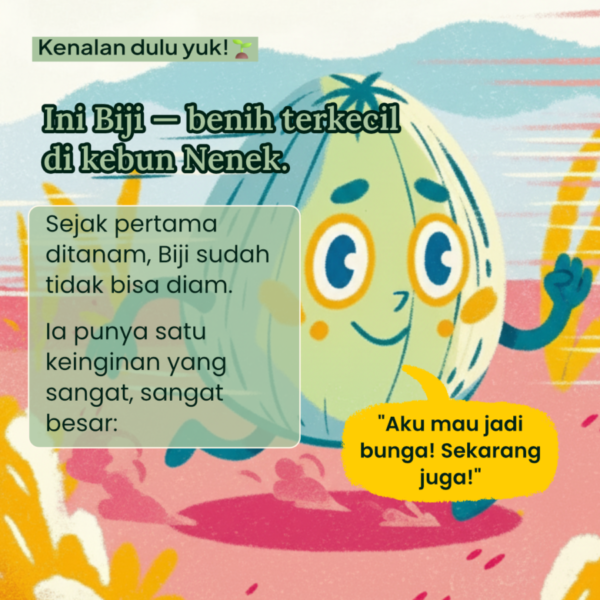
Since it was first put in the ground, the Seed has been impatient.
When did I become a flower? When? When?
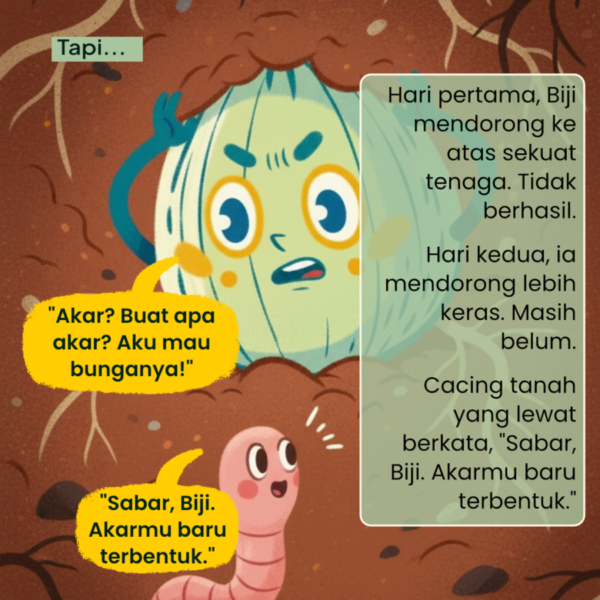
The first day on the ground, Biji pushed himself with all his might.
“Come on! Come on! I’m going out!” he exclaimed in his heart.
But the soil on it is thick, and the seeds are too small.
An earthworm snaked past, calm and relaxed.
“Eh, Worm! Why haven’t I grown yet? I’m ready to become a flower!” Biji protested.
Worm stopped and looked at Biji sensibly. “Be patient, Biji. Your roots are just starting to form. That’s the most important thing first.”
“Roots? What are roots for? I want the flowers, not the roots!”
Worm just smiled and wriggled away.
The second day, Biji became increasingly restless.
Have the other seeds grown yet? I’m definitely the slowest. I’m definitely the smallest. I’m sure I won’t be a pretty flower.
Biji pushed again, harder than yesterday.
And even more difficult.
Until he felt very tired and very sad.
He gave up and curled up on the ground. Maybe I just can’t.
The third day, something happened.

Is raining.
First plan— tick, tick, tick — then it got stronger. The water seeped slowly into the soil, penetrating layer after layer, until it finally touched Biji who was curled up there.
And Biji felt something strange.
Warm. Wet. Comfortable.
Oh.
The small roots which were previously stiff slowly began to expand. Like little fingers that had just woken up from a long sleep, stretching out, gripping the ground around them.
So this is what Worm means. The roots must be strong before the stem can grow. The stem must be upright before the flowers can bloom.
For the first time, Biji did not forcefully push.
He was just… silent. And let himself grow.
A week later, small green shoots emerged from the surface of the soil.
A month later, the stems are upright and strong, the leaves are wide and fresh.
And one fine morning — when the dew still clung to the grass and the birds were just beginning to sing — a bright yellow flower blooms for the first timefacing the sun proudly.
The old grandmother walked into the garden that morning and immediately saw it. He stopped, smiled broadly, and bowed slightly towards the flower.
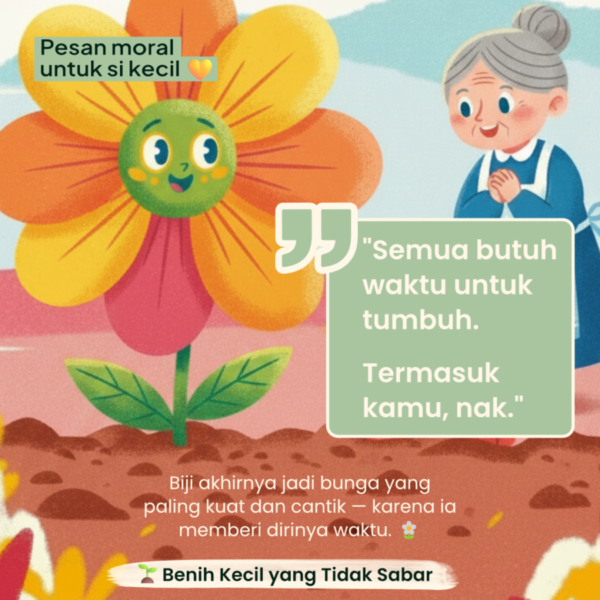
“You are very beautiful,” said Grandma.
“Thank you, Grandma,” said the flower — which of course was a seed that had grown. “I now understand why I had to wait. If I had rushed yesterday, perhaps I wouldn’t be as straight and beautiful as I am now.”
Grandma nodded. “That’s how it is, Biji. All living things have their own time to grow. Including you.”
“Including me,” Biji repeated quietly — and this time, she really understood what it meant.
💬 Reflection Questions for Moms & Children
After the story is finished, while hugging your little one, try asking:
- “What are you waiting for now? Maybe waiting to be able to ride a bicycle? Waiting for your little brother to be born? Waiting for your birthday?”
- “If you were Biji, would you be patient or impatient?”
- “Why do you think Seeds have to wait before they can become beautiful flowers?”
The third question is the best, Moms — because the answer is not one, and children will start to think for themselves about the concepts of process and time.
Happy storytelling tonight, Moms!
And don’t forget to check [LINK: dongeng pengantar tidur anak SuperMom lainnya] for a collection of stories that Moms can read directly.
Want to get more stories and support from fellow Moms? Click the button below to join the Supermom community.
PakarPBN
A Private Blog Network (PBN) is a collection of websites that are controlled by a single individual or organization and used primarily to build backlinks to a “money site” in order to influence its ranking in search engines such as Google. The core idea behind a PBN is based on the importance of backlinks in Google’s ranking algorithm. Since Google views backlinks as signals of authority and trust, some website owners attempt to artificially create these signals through a controlled network of sites.
In a typical PBN setup, the owner acquires expired or aged domains that already have existing authority, backlinks, and history. These domains are rebuilt with new content and hosted separately, often using different IP addresses, hosting providers, themes, and ownership details to make them appear unrelated. Within the content published on these sites, links are strategically placed that point to the main website the owner wants to rank higher. By doing this, the owner attempts to pass link equity (also known as “link juice”) from the PBN sites to the target website.
The purpose of a PBN is to give the impression that the target website is naturally earning links from multiple independent sources. If done effectively, this can temporarily improve keyword rankings, increase organic visibility, and drive more traffic from search results.