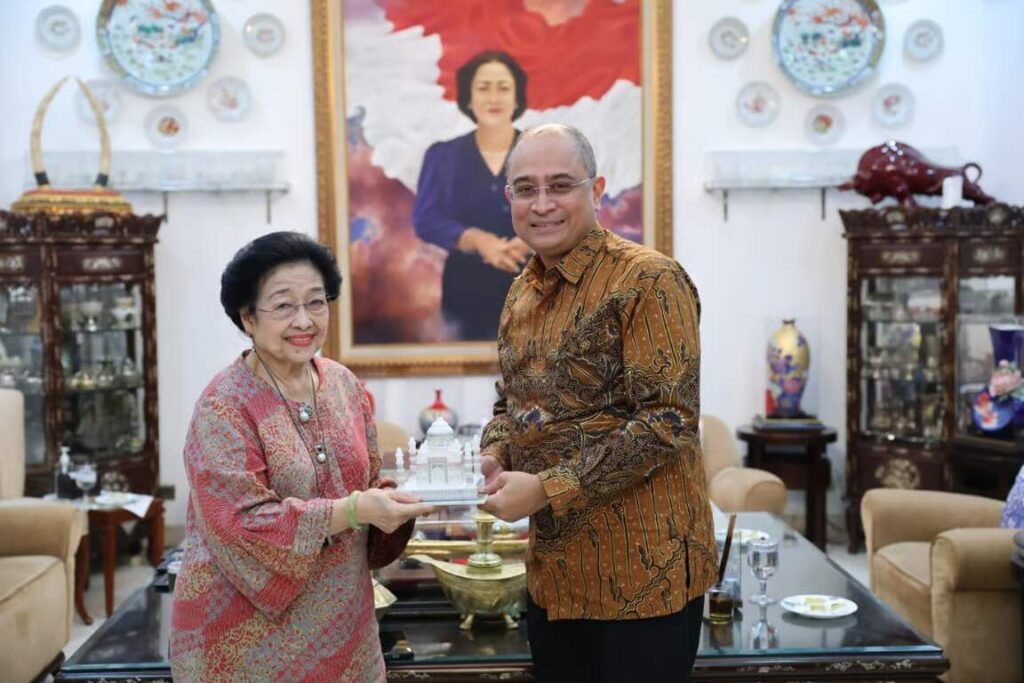
Ambassador Sandeep and Megawati revive traces of Soekarno-Nehru friendship
The long relationship between Indonesia and India was again in the spotlight when the Indian Ambassador to Indonesia, Sandeep Chakravorty visited the 5th President of the Republic of Indonesia Megawati Soekarnoputri at her residence in Menteng, Central Jakarta, Monday (25/5/2026). The meeting was not just an ordinary diplomatic agenda, but turned into a nostalgic space that revealed the historical roots of relations between the two countries since the era of President Soekarno and India’s first Prime Minister, Jawaharlal Nehru.
In a warm atmosphere filled with stories from the past, Megawati and Sandeep discussed how the personal closeness between the two founding figures of the nation is the foundation of relations between Indonesia and India to this day. The discussion not only touched on history, but also expanded to issues of geopolitics, democracy, and even global challenges facing the two countries.
The meeting showed that relations between Indonesia and India were not built solely on modern diplomatic interests, but were rooted in ideological friendship that had existed since the struggle for independence.
Megawati’s Memories with Nehru
Megawati opened the conversation by reminiscing about her personal experience when attending the High Level Conference of the Non-Aligned Movement in Belgrade, Yugoslavia, from 1 to 6 September 1961. At that time, Megawati was still 14 years old, but had participated in the Indonesian delegation and met directly with a number of big world figures.
He recalled how he sat with the founders of the Non-Aligned Movement, including Jawaharlal Nehru. This moment became one of the experiences that left a lasting impression in his life.
“I was wearing a kebaya at that time,” said Megawati, showing an old photo of her meeting with Nehru.
Megawati also showed a number of other historical documentation, including a photo of Nehru talking with President Soekarno at the Merdeka Palace on June 8 1950. In the photo, Guntur Soekarnoputra can be seen riding a bicycle while carrying little Megawati.
These stories illustrate how relations between Indonesia and India at that time not only took place at the state level, but also felt close on a personal level between the families of the leaders.
Apart from remembering Nehru, Megawati also touched on her close relationship with Bijayananda “Biju” Patnaik, an Indian independence figure and legendary pilot who was known to have close ties with Indonesia during the struggle.
Foundations of Diplomacy from the Two Founding Fathers
Indian Ambassador Sandeep Chakravorty assessed that the relationship built by Soekarno and Nehru had become an important diplomatic legacy for both countries. According to him, the closeness of the two figures is still felt in bilateral relations between Indonesia and India to this day.
“To date, good relations between the two countries have been established and built by the two Fathers of the Nation, President Soekarno and PM Nehru,” said Sandeep.
He also revealed that traces of the history of the Soekarno family still have a special place in India. During a visit to the Nehru Museum in New Delhi, Sandeep admitted that he saw a photo of Megawati and Sukarno displayed there.
“I also saw photos of Mrs. Megawati and Sukarno displayed at the Nehru Museum in New Delhi,” he said.
Sandeep himself is not a new figure for Megawati. He admitted that he had met Megawati in North Korea in 2011 and met again at the G20 Summit Gala Dinner in Bali in 2022. According to him, this meeting in Menteng felt very personal because it was filled with historical memories and reflections on the relationship between the two countries.
“It was a great honor to meet Mrs. Megawati Sukarnoputri, former President of Indonesia and daughter of President Sukarno. She is a living symbol of the close relationship between our two countries and our meeting felt very warm with stories of memories from the past,” said Sandeep.
Diplomacy Built on Symbols and Proximity
During the meeting, Megawati also told how President Soekarno previously chose the location of the Indian embassy in Indonesia. In return, Nehru then helped find the location of the Indonesian embassy in New Delhi, which was close to the residence of the Indian Prime Minister at that time.
This story shows that diplomacy in the early days of independence was not only realized through formal cooperation, but also through symbols of closeness and personal respect between state leaders.
India itself is known as one of the first countries to recognize Indonesia’s independence. This support is an important part of the history of bilateral relations between the two countries, especially amidst the dynamics of global politics after World War II and the birth of new countries in Asia.
Until now, relations between Indonesia and India continue to develop in various sectors, ranging from trade, technology, education, to strategic cooperation in the Indo-Pacific region.
Discuss Geopolitics and the Future of Democracy
Apart from historical nostalgia, discussions at the meeting also touched on broader global issues. PDI Perjuangan Secretary General, Hasto Kristiyanto, said Megawati and Sandeep participated in discussions regarding international geopolitical developments and challenges to democracy.
“Earlier in the meeting, strategic matters related to geopolitics and how to improve the quality of democracy and relations between the two countries were also discussed,” said Hasto.
Discussions about democracy are relevant considering that Indonesia and India are both known as large democracies in Asia with very large populations and complex social diversity.
In an ever-changing global context, both countries are considered to have the same interest in maintaining regional stability while strengthening the position of developing countries in the world arena.
The meeting then closed with an exchange of souvenirs. Sandeep handed over a miniature Taj Mahal as a symbol of India, while Megawati handed over a miniature Pinisi ship and an endek woven shirt as a representation of Indonesian culture.
The moment became a small symbol of the two countries’ long relationship built not only by political interests, but also by historical memory, cultural respect and friendship across generations.
This press release has also appeared on VRITIMES
PakarPBN
A Private Blog Network (PBN) is a collection of websites that are controlled by a single individual or organization and used primarily to build backlinks to a “money site” in order to influence its ranking in search engines such as Google. The core idea behind a PBN is based on the importance of backlinks in Google’s ranking algorithm. Since Google views backlinks as signals of authority and trust, some website owners attempt to artificially create these signals through a controlled network of sites.
In a typical PBN setup, the owner acquires expired or aged domains that already have existing authority, backlinks, and history. These domains are rebuilt with new content and hosted separately, often using different IP addresses, hosting providers, themes, and ownership details to make them appear unrelated. Within the content published on these sites, links are strategically placed that point to the main website the owner wants to rank higher. By doing this, the owner attempts to pass link equity (also known as “link juice”) from the PBN sites to the target website.
The purpose of a PBN is to give the impression that the target website is naturally earning links from multiple independent sources. If done effectively, this can temporarily improve keyword rankings, increase organic visibility, and drive more traffic from search results.


