President Encourages Downstreaming of Gambir, PTPN Group Ready to Strengthen Added Value of People’s Commodities
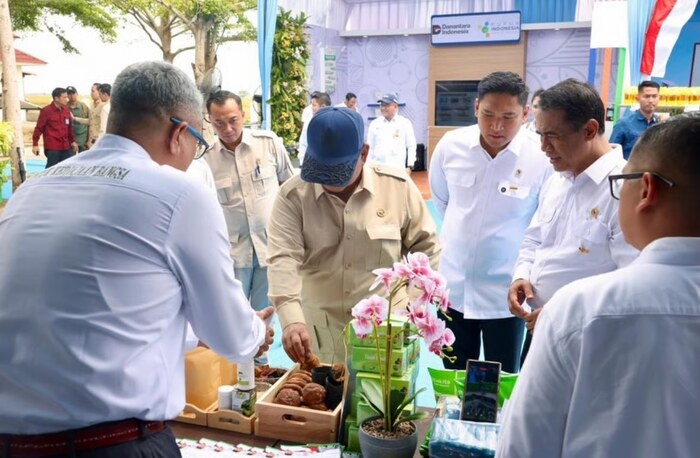
Karawang – President of the Republic of Indonesia Prabowo Subianto stated the importance of strengthening the downstreaming and use of technology in the agricultural and plantation sectors as the main strategy to improve the welfare of farmers while strengthening the competitiveness of the national economy. This statement was made by the President when reviewing the harvest and the announcement of food self-sufficiency in Karawang, West Java (8/1/2025).
During the visit, the President reviewed the use of modern agricultural tools and machinery as well as seeing a number of downstream products based on national superior commodities. One commodity that is attracting attention is gambier, an endemic Indonesian plant which is considered to have great global economic potential.
The President emphasized that Indonesia must not continue to be in the position of a supplier of raw materials. According to him, commodities such as gambier need to be encouraged to be further processed domestically to provide greater added value, open up new industrial opportunities, and increase farmers’ income in production centers.
This encouragement is a strong signal for BUMN in the plantation sector, including entities under the PTPN III (Persero) Nusantara Perkebunan Holding, to take a more active role in building a downstream ecosystem based on research, technology and partnerships with smallholder farmers.
Gambir: Strategic Potential of Global Value
President Director of PTPN IV PalmCo, a palm oil subholding under Holding Perkebunan Nusantara, Jatmiko K. Santosa, explained that gambier is a commodity that has so far received little public attention, even though it has strong advantages in the international market.
“When people hear gambier, they usually immediately think of betel. Even though gambier is a strategic product. There are even countries where around 90 percent of their gambier needs are supplied from Indonesia,” said Jatmiko.
He added that gambier has a very high antioxidant content, even more than green tea, which is widely known as a health product. This content opens up opportunities for the development of various value-added derivative products.
“Gambier can become various food ingredients such as tea and also raw materials for cosmetics, soap, shampoo, and even industrial needs. The tannins are even used as election ink. This shows how widely used gambier is,” he said.
According to Jatmiko, the majority of Indonesian gambier is still exported in the form of raw materials. This condition causes more added value to be enjoyed by processing countries. Therefore, downstreaming is considered to be a crucial step so that economic benefits can be felt directly by farmers and local communities.
Increasing Productivity as a First Step
Jatmiko emphasized that the first step in developing gambier is increasing productivity at the farmer level. Currently, the productivity of people’s gambier is still in the range of 0.5 tonnes per hectare.
“With a research approach and better processing methods for gambier leaves, productivity can be increased to 0.75 tons or even up to 1 ton per hectare. This means there is the potential for an increase of 50 to 100 percent. The impact will be direct on farmers’ income,” he explained.
These efforts will be strengthened by plans to build gambier processing facilities that are tailored to research results and market needs. According to him, downstream industrial development must be in line with market demand to be sustainable.
“We can’t just build a factory without looking at the market. What products are accepted the fastest, have strong demand, and have the opportunity to be dominated by the market, that’s what we have to push first,” said Jatmiko.
Academic Support and Geographical Advantage
From an academic perspective, Researcher and Director of Research Collaboration and Downstreaming at the Faculty of Agricultural Technology, Andalas University, Dr.Eng Muhammad Makky, S.TP, M.Si, emphasized that Gambir has very specific geographical advantages.
“Geographically, Sumatra is an endemic area for gambier plants. Gambir grows in West Sumatra, North Sumatra, parts of Aceh, Riau and the Riau Islands. However, the most supportive ones in terms of abiotic conditions and ecosystems are West Sumatra and North Sumatra,” he explained.
According to Dr. Makky, these natural advantages make gambier difficult to develop in other countries. However, this comparative advantage needs to be strengthened by increasing productivity and strengthening downstream industries.
“The comparative advantage already exists. The challenge now is how to increase productivity and ensure that gambier results are processed into high-value products. This is where research and technology play an important role,” he said.
As a former World Bank consultant, he believes that collaboration between BUMN, universities and farmers is the key so that gambier development can be sustainable and have a broad economic impact.
Momentum for Downstreaming People’s Commodities
The President’s encouragement of the downstreaming of gambier is considered an important momentum for the development of people’s commodities based on local excellence. Through the synergy of research, increasing productivity and developing the processing industry, gambier has the potential to become a superior export product as well as a driving force for the regional economy in the production center of Sumatra.
This effort is in line with the commitment of Holding Perkebunan Nusantara PTPN III (Persero) in encouraging the downstreaming of national plantation commodities in order to create added value, strengthen food security and improve the welfare of farmers in a sustainable manner.
News
Berita Teknologi
Berita Olahraga
Sports news
sports
Motivation
football prediction
technology
Berita Technologi
Berita Terkini
Tempat Wisata
News Flash
Football
Gaming
Game News
Gamers
Jasa Artikel
Jasa Backlink
Agen234
Agen234
Agen234
Resep
Cek Ongkir Cargo
Download Film

Related Posts

82% Net Zero target has not been verified by scope 3 emission data, so a critical issue in corporate climate strategies
Situs Slot Online dengan Metode Deposit Terlengkap